|
 |
 |
 |
 |
 |
 |
Earth-sized telescope set to snap first picture of a black hole
The Event Horizon Telescope will take images of the black hole at the centre of our galaxy, and could reveal how relativity and quantum mechanics mesh
GET ready to peer into the unknown. This week, we will have our first chance to take a picture of the supermassive black hole at the centre of our galaxy. The image could teach us how black holes work and even how the largest and smallest forces governing the universe fit together.
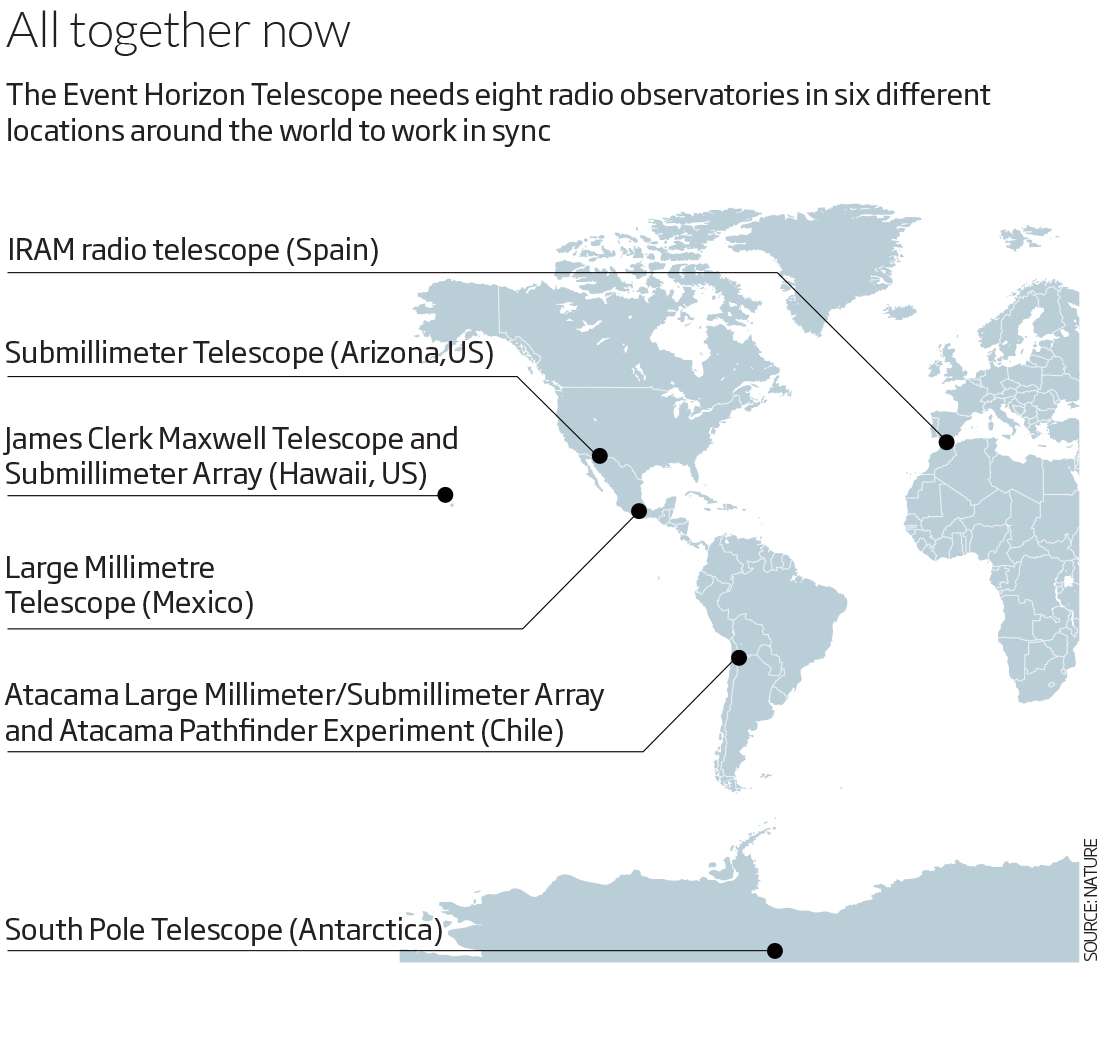
The Event Horizon Telescope is switching on. It consists of eight radio observatories around the world, including telescopes in Spain, the US and Antarctica (see map). And for just four or five nights between 5 and 14 April, if the weather is clear at all of the observatories, they will all turn on at once.
“Event horizons have been part of the mythology of science, but they will become real”
Each telescope will point at Sagittarius A*, the supermassive black hole at the centre of the Milky Way, and measure every radio wave coming from its direction. Linking together observatories spread across such a huge area and combining their observations to filter out extra light will effectively create a powerful “virtual telescope” almost the size of Earth.
These telescopes will together capture sharper and more detailed data than we’ve ever had from Sagittarius A*, which we still know very little about, as well as the larger black hole at the centre of nearby galaxy M87.
With the telescopes generating a total of 2 petabytes of data per night – enough to store the full genomes of some 2 billion people – astronomers hope to take the first image of the event horizon around a black hole, and the bright matter hurtling around it.
|
|
 |
 |
 |
 |
 |
 |
 |
 |
 |
 |
 |
 |
 |
 |
 |
 |
 |
 |
 |
 |
 |
 |
 |
 |
 |
 |
 |
 |
 |
 |
 |
 |
 |
 |
 |
 |
 |
 |
 |
 |
 |
 |
 |
 |
 |
 |
 |
 |
 |
 |
 |
 |
 |
 |
 |