
 |
 |
 |
 |
 |
 |
 |
What Depression Is Really Like

In a piercing letter to his brother, Vincent van Gogh captured the mental anguish of depression in a devastatingly perfect visceral metaphor: “One feels as if one were lying bound hand and foot at the bottom of a deep dark well, utterly helpless.” Anyone who has suffered from this debilitating disease knows that the water in that well is qualitatively, biochemically different from the water in the puddle of mere sadness. And yet, even as scientists are exploring the evolutionary origins of depression and the role REM sleep may play in it, understanding and articulating the experience of the disease remains a point of continual frustration for those afflicted and a point of continual perplexity for those fortunate never to have plummeted to the bottom of the well.
No one has captured this perennial plague of the human spirit with greater vividness and acuity than William Styron (June 11, 1925–November 1, 2006) in Darkness Visible (public library) — his trenchant 1990 memoir of depression.
Styron, who first descended into clinical depression at the age of sixty and describes himself as “one who has suffered from the malady in extremis yet returned to tell the tale,” considers the cultural baggage of this “veritable howling tempest in the brain,” propelled by “the intermingled factors of abnormal chemistry, behavior and genetics”:
When I was first aware that I had been laid low by the disease, I felt a need, among other things, to register a strong protest against the word “depression.” Depression, most people know, used to be termed “melancholia,” a word which appears in English as early as the year 1303 and crops up more than once in Chaucer, who in his usage seemed to be aware of its pathological nuances. “Melancholia” would still appear to be a far more apt and evocative word for the blacker forms of the disorder, but it was usurped by a noun with a bland tonality and lacking any magisterial presence, used indifferently to describe an economic decline or a rut in the ground, a true wimp of a word for such a major illness. It may be that the scientist generally held responsible for its currency in modern times, a Johns Hopkins Medical School faculty member justly venerated — the Swiss-born psychiatrist Adolf Meyer — had a tin ear for the finer rhythms of English and therefore was unaware of the semantic damage he had inflicted by offering “depression” as a descriptive noun for such a dreadful and raging disease. Nonetheless, for over seventy-five years the word has slithered innocuously through the language like a slug, leaving little trace of its intrinsic malevolence and preventing, by its very insipidity, a general awareness of the horrible intensity of the disease when out of control.
One of the most striking paradoxes of the disease is that despite its devastating prevalence — depression is the most common form of disability in the world today — its symptoms are so imperceptible from the outside that it is extremely difficult to tell who is suffering and who is not. And yet what goes on inside is acute and unmistakable. Styron captures it with penetrating precision:
The gray drizzle of horror induced by depression takes on the quality of physical pain. But it is not an immediately identifiable pain, like that of a broken limb. It may be more accurate to say that despair, owing to some evil trick played upon the sick brain by the inhabiting psyche, comes to resemble the diabolical discomfort of being imprisoned in a fiercely overheated room. And because no breeze stirs this caldron, because there is no escape from this smothering confinement, it is entirely natural that the victim begins to think ceaselessly of oblivion.
From visual educators at TED Ed — who have previously explored the history of melancholy — comes this animated primer on what depression really is and how to best be there for those afflicted:
For an elevating counterpoint, see Tchaikovsky — a lifelong sufferer of the disease — on depression and finding beauty amid the wreckage of the soul.
“The most beautiful experience we can have is the mysterious,”Einstein wrote, “the fundamental emotion which stands at the cradle of true art and true science.” Hardly any contemporary writer has done more to illuminate that cradle than Alan Lightman. A physicist and a novelist, and MIT’s first professor with dual appointments in science and the humanities, he is one of those rare intellectual amphibians who inhabit the worlds of art and science with equal grace. In his incomparable writing, Lightman continually uncovers what he calls the “creative sympathies” between these two worlds — sympathies nowhere more similar than in the singular scintillation of creative breakthrough common to both realms, which he articulates beautifully in the opening essay from his altogether magnificent 2005 collection A Sense of the Mysterious: Science and the Human Spirit (public library).
Reflecting on his first love affair with original research as a 22-year-old graduate student at Caltech, Lightman recounts a trying project aimed at procuring “a giant umbrella theory of gravity” by writing down countless equations. However much he toiled, the calculations just didn’t add up. For months, his pencil trembled with the sense that something was off, but the source of the error evaded him.
And then, much like the periodic table arranged itself in Mendeleev’s unconscious mind during a dream, the breakthrough arrived in accordance with Lewis Carroll’sremedy for creative block. Lightman describes that miraculous moment:
One morning, I remember that it was a Sunday morning, I woke up about five a.m. and couldn’t sleep. I felt terribly excited. Something strange was happening in my mind. I was thinking about my research problem, and I was seeing deeply into it. I was seeing it in ways I never had before. The physical sensation was that my head was lifting off my shoulders. I felt weightless. And I had absolutely no sense of my self. It was an experience completely without ego, without any thought about consequences or approval or fame. Furthermore, I had no sense of my body. I didn’t know who I was or where I was. I was simply spirit, in a state of pure exhilaration.
Psychologists have termed this state “flow.” But although the resulting breakthrough is the fruit of the lengthy labor preceding it — one ripened by what T.S. Eliot called the “incubation” at the root of creativity — when it arrives, it feels like an unmerited grace. Lightman captures this intoxicating feeling:
The best analogy I’ve been able to find for that intense feeling of the creative moment is sailing a round-bottomed boat in strong wind. Normally, the hull stays down in the water, with the frictional drag greatly limiting the speed of the boat. But in high wind, every once in a while the hull lifts out of the water, and the drag goes instantly to near zero. It feels like a great hand has suddenly grabbed hold and flung you across the surface like a skimming stone. It’s called planing.
That Sunday morning, he woke up planing:
Although I had no sense of my ego, I did have a feeling of rightness. I had a strong sensation of seeing deeply into the problem and understanding it and knowing that I was right — a certain kind of inevitability. With these sensations surging through me, I tiptoed out of my bedroom, almost reverently, afraid to disturb whatever strange magic was going on in my head, and I went to the kitchen. There, I sat down at my ramshackle kitchen table. I got out the pages of my calculations, by now curling and stained. A tiny bit of daylight was starting to seep through the window.
In a sentiment that calls to mind Hemingway’s admonition to work alone, Agnes Martin’s assertion that “the best things in life happen to you when you’re alone,” and Keats’s exaltation of solitude as the seedbed of the imagination, Lightman adds:
Although I was oblivious to myself, my body, and everything around me, the fact is I was completely alone. I don’t think any other person in the world would have been able to help me at that moment. And I didn’t want any help. I had all of these sensations and revelations going on in my head, and being alone with all that was an essential part of it.
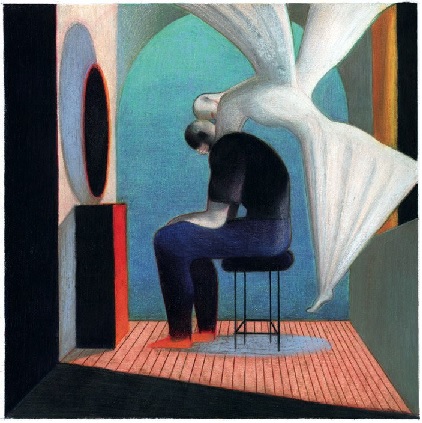
At that solitary kitchen table, Lightman finally solved his problem and proved that that the conjecture at the heart of his theory was true. He would go on to have similar revelations over the years, not only in other scientific projects but also in his work as a novelist. He writes of this supreme testament to the common creative force animating art and science:
As a novelist, I’ve experienced the same sensation. When I suddenly understand a character I’ve been struggling with, or find a lovely way of describing a scene, I am lifted out of the water, and I plane. I’ve read the accounts of other writers, musicians, and actors, and I think that the sensation and process are almost identical in all creative activities. The pattern seems universal: The study and hard work. The prepared mind. The being stuck. The sudden shift. The letting go of control. The letting go of self.
This act of letting go, Lightman suggests, is a surrender to the mystery of life. With an eye to Einstein’s famous proclamation, he considers the meaning of the mysterious:
I believe that [Einstein] meant a sense of awe, a sense that there are things larger than us, that we do not have all the answers at this moment. A sense that we can stand right at the edge between known and unknown and gaze into that cavern and be exhilarated rather than frightened… I have experienced that beautiful mystery both as a physicist and as a novelist. As a physicist, in the infinite mystery of physical nature. As a novelist, in the infinite mystery of human nature and the power of words to portray some of that mystery.
Lightman’s A Sense of the Mysterious remains one of the finest, most poetic science books ever written. Complement this particular fragment with Hannah Arendt on the life-expanding value of unanswerable questions and Marcelo Gleiser on how to live with mystery in the age of knowledge, then revisit Lightman on science and spiritualityand why we long for immortality in an impermanent universe.
In 1989, Paris Review founding editor and trailblazing interviewer George Plimpton edited a wonderful collection titled The Writer’s Chapbook: A Compendium of Fact, Opinion, Wit, and Advice from the 20th Century’s Preeminent Writers (public library). Among them was novelist, poet, essayist, and playwright James Baldwin (August 2, 1924–December 1, 1987), whom Plimpton had interviewed on two separate occasions in early 1984, half a century after Baldwin read his way out of Harlem and into the pantheon of literary greatness.
In a fantastic addition to the collected wisdom of celebrated writers, Baldwin looks back on his formidable career and shares what he has learned about the creative process, the psychological drivers of writing, and the habits of mind one must cultivate in order to excel at the craft.
Reflecting on what motivates great writers to write — an enduring question also addressed beautifully by George Orwell, David Foster Wallace, Italo Calvino, and William Faulkner — Baldwin sides with Bukowski and argues that the supreme animating force of the writer is the irrepressible impossibility of not-writing:
Something that irritates you and won’t let you go. That’s the anguish of it. Do this book, or die. You have to go through that. Talent is insignificant. I know a lot of talented ruins. Beyond talent lie all the usual words: discipline, love, luck, but most of all, endurance.
Endurance, indeed, is perhaps the sole common denominator among successful authors. Any aspiring writer, he admonishes, should have no illusion about the endurance required but should want to write anyway. A generation after Jack Kerouac considered the vital difference between talent and genius, Baldwin notes:
If you are going to be a writer there is nothing I can say to stop you; if you’re not going to be a writer nothing I can say will help you. What you really need at the beginning is somebody to let you know that the effort is real.
In a sentiment reminiscent of Joan Didion’s observation that she writes in order to gain better access to her own mind, Baldwin speaks to the consciousness-clarifying function of the creative impulse:
When you’re writing, you’re trying to find out something which you don’t know. The whole language of writing for me is finding out what you don’t want to know, what you don’t want to find out. But something forces you to anyway.
Much of that self-revelation, Baldwin points out, happens not during the first outpour of writing but during the grueling process of rewriting. Echoing Hemingway’s abiding wisdom on the crucial art of revision, he adds:
Rewriting [is] very painful. You know it’s finished when you can’t do anything more to it, though it’s never exactly the way you want it… The hardest thing in the world is simplicity. And the most fearful thing, too. You have to strip yourself of all your disguises, some of which you didn’t know you had. You want to write a sentence as clean as a bone. That is the goal.
But as essential as that sense of incompleteness may be in guiding the revision process, it must be mediated by the awareness that completeness is a perennial mirage. (Decades later, Zadie Smith would observe in her ten rules of writing: “Resign yourself to the lifelong sadness that comes from never being satisfied.”) Baldwin offers:
When you’ve finished a novel, it means, “The train stops here, you have to get off here.” You never get the book you wanted, you settle for the book you get. I’ve always felt that when a book ended there was something I didn’t see, and usually when I remark the discovery it’s too late to do anything about it.
Adding to the endlessly fascinating daily rhythms of great writers, which reflect the wide range of differences in the cognitive conditions of the ideal writing routine, Baldwin shares his work habits:
I start working when everyone has gone to bed. I’ve had to do that ever since I was young — I had to wait until the kids were asleep. And then I was working at various jobs during the day. I’ve always had to write at night. But now that I’m established I do it because I’m alone at night.
Complement The Writer’s Chapbook — a treasure so wisdom-packed that it is a tragedy to see it fall out of print — with Joseph Conrad on what makes a great writer, Willa Cather on the life-changing advice that made her a writer, and Jane Kenyon on what remains the finest ethos to write and live by, then revisit Baldwin on the artist’s role in societyand his terrifically timely conversation with Margaret Mead about race and identity.
“Artists have no choice but to express their lives,” Anne Truitt wrote in her penetrating reflection on the crucial difference between being an artist and making art. This creative inevitability is at the center of artistic endeavor and has been articulated by a multitude of humanity’s most celebrated artists. “Every good artist paints what he is,”Jackson Pollock asserted in his final interview.
So why, then, do we so readily reduce works of art to objects and commodities, forgetting that they are at heart transfigurations of lived human experience?
My recent conversation with Amanda Palmer about patronage and the future of art reminded me of Art as Experience (public library) — a terrific little book by the pioneering philosopher, psychologist, and education reformer John Dewey (October 20, 1859–June 1, 1952), based on a series of ten lectures he delivered at Harvard in the winter and spring of 1931, in which he addresses this very question.
In the opening essay, titled “The Live Creature,” Dewey argues that by reducing works of art to material products — paintings, buildings, books, music albums — we forget that “the actual work of art is what the product does with and in experience.”
Considering the need to “restore the continuity between the refined and intensified forms of experience that are works of art and the everyday events, doings, and sufferings” of the human experience, he writes:
When artistic objects are separated from both conditions of origin and operation in experience, a wall is built around them that renders almost opaque their general significance… Art is remitted to a separate realm, where it is cut off from that association with the materials and aims of every other form of human effort, undergoing, and achievement.
[…]
In order to understand the esthetic in its ultimate and approved forms, one must begin with it in the raw; in the events and scenes that hold the attentive eye and ear of man, arousing his interest and affording him enjoyment as he looks and listens: the sights that hold the crowd — the fire-engine rushing by; the machines excavating enormous holes in the earth; the human-fly climbing the steeple-side; the men perched high in air on girders, throwing and catching red-hot bolts. The sources of art in human experience will be learned by him who sees how the tense grace of the ball-player infects the onlooking crowd; who notes the delight of the housewife in tending her plants, and the intent interest of her goodman in tending the patch of green in front of the house; the zest of the spectator in poking the wood burning on the hearth and in watching the darting flames and crumbling coals.
[…]
The intelligent mechanic engaged in his job, interested in doing well and finding satisfaction in his handiwork, caring for his materials and tools with genuine affection, is artistically engaged.
What severed this intimate relationship between art and experience, Dewey argues, is the rise of capitalism, which removed art from life by making it a commodity of class, status, or taste. He writes:
Objects that were in the past valid and significant because of their place in the life of a community now function in isolation from the conditions of their origin. By that fact they are also set apart from common experience, and serve as insignia of taste and certificates of special culture.
[This is] deeply affecting the practice of living, driving away esthetic preconceptions that are necessary ingredients of happiness, or reducing them to the level of compensating transient pleasurable excitations.
Art by Shaun Tan for a special edition of the Brothers Grimm fairy tales
Art in its proper form, Dewey suggests, transmutes the common activities of human life into matters of aesthetic value. Any theory seeking an understanding of art must therefore be concerned with understanding the larger ecosystem of experience from which art springs. In a sentiment that calls to mind Richard Feynman’s memorable“ode to a flower” — a parallel that exposes the common ground between true science and true art — Dewey observes:
Flowers can be enjoyed without knowing about the interactions of soil, air, moisture, and seeds of which they are the result. But they cannot be understood without taking just these interactions into account — and theory is a matter of understanding.
[…]
It is a commonplace that we cannot direct, save accidentally, the growth and flowering of plants, however lovely and enjoyed, without understanding their causal conditions. It should be just a commonplace that esthetic understanding — as distinct from sheer personal enjoyment — must start with the soil, air, and light out of which things esthetically admirable arise. And these conditions are the conditions and factors that make an ordinary experience complete.
Dewey’s most salient point — a point that applies not only to art but to our deepest sense of ourselves as agents of aliveness — deals precisely with this question of completeness. Life, like art, is never complete without what he so poetically calls “all the rhythmic crises that punctuate the stream of living.” Our creaturely destiny is intimately entwined with the realities of nature, and nature is forever oscillating between mutually necessary highs and lows. Echoing Nietzsche’s immortal wisdom on why a fulfilling life requires embracing rather than running from difficulty, Dewey writes:
The career and destiny of a living being are bound up with its interchanges with its environment.
[…]
Life grows when a temporary falling out is a transition to a more extensive balance of the energies of the organism with those of the conditions under which it lives.
These biological commonplaces are something more than that; they reach to the roots of the esthetic in experience. The world is full of things that are indifferent and even hostile to life; the very processes by which life is maintained tend to throw it out of gear with its surroundings. Nevertheless, if life continues and if in continuing it expands, there is an overcoming of factors of opposition and conflict; there is a transformation of them into differentiated aspects of a higher power and more significant life… Here in germ are balance and harmony attained through rhythm. Equilibrium comes about not mechanically and inertly but out of, and because of, tension… Changes interlock and sustain one another. Wherever there is this coherence there is endurance.
In a sentiment that calls to mind children’s literature patron saint Ursula Nordstrom — “That is the creative artist — a penalty of the creative artist,” she wrote in her beautiful letter of encouragement to a young and insecure Maurice Sendak, “wanting to make order out of chaos.” — Dewey adds:
Order is not imposed from without but is made out of the relations of harmonious interactions that energies bear to one another. Because it is active…order itself develops… Order cannot but be admirable in a world constantly threatened with disorder.
For only when an organism shares in the ordered relations of its environment does it secure the stability essential to living. And when the participation comes after a phase of disruption and conflict, it bears within itself the germs of a consummation akin to the esthetic.
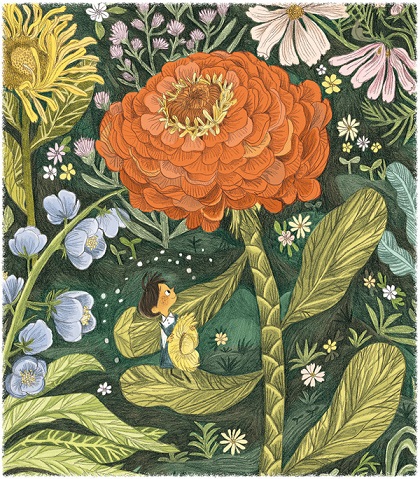
Art by Emily Hughes from Little Gardener
The artist — that is, the creatively whole human being — is one who embraces this harmonious interplay, with both its positive and negative energies. Dewey writes:
Since the artist cares in a peculiar way for the phase of experience in which union is achieved, he does not shun moments of resistance and tension. He rather cultivates them, not for their own sake but because of their potentialities, brining to living consciousness and experience that is unified and total.
Speaking to what Alan Lightman would so lyrically term the “creative sympathies” of art and science many decades later, Dewey considers the deep commonalities beneath the surface contrasts between these two modes of understanding human experience:
In contrast with the person whose purpose is esthetic, the [scientist] is interested in problems, in situations wherein tension between the matter of observation and of thought is marked. Of course he cares for their resolution. But he does not rest in it; he passes on to another problem using an attained solution only as a stepping stone from which to set on foot further inquiries.
[…]
The odd notion that an artist does not think and a scientific inquirer does nothing else is the result of converting a difference of tempo and emphasis into a difference in kind. The thinker has his esthetic moment when his ideas case to be mere ideas and become the corporate meanings of objets. The artist has his problems and thinks as he works. Bu this thought is more immediately embodied in the object. Because of the comparative remoteness of his end, the scientific worker operates with symbols, words and mathematical signs. The artist does his thinking in the very qualitative media he works in, and the terms lie so close to the object that he is producing that they merge directly into it.
With this, Dewey returns to the indelible interchanges between the human animal and its environment, out of which arises the experience that becomes art — experience that encompasses the full spectrum of darkness and light, ever-flowing into one another. He writes:
Direct experience comes from nature and man interacting with each other. In this interaction, human energy gathers, is released, dammed up, frustrated and victorious. There are rhythmic beats of want and fulfillment, pulses of doing and being withheld from doing.
All interactions that effect stability and order in the whirling flux of change are rhythms. There is ebb and flow, systole and diastole: ordered change… Contrast of lack and fullness, of struggle and achievement, of adjustment after consummated irregularity, form the drama in which action, feeling, and meaning are one. The outcome is balance and counterbalance.
This dance of balance and counterbalance, Dewey reminds us, is the beauty of life and a function of life’s singular conditions — it is possible neither in a world of frantic flux without rhythm, nor in a static world calcified into immutability:
In a world of mere flux, change would not be cumulative; it would not move toward a close. Stability and rest would have no being. Equally it is true, however, that a world that is finished, ended, would have no traits of suspense and crisis, and would offer no opportunity for resolution. Where everything is already complete, there is no fulfillment… The live being recurrently loses and reestablishes equilibrium with his surroundings. The moment of passage from disturbance into harmony is that of intensest life. In a finished world, sleep and waking could not be distinguished. In one wholly perturbed, conditions could not even be struggled with. In a world made after the pattern of ours, moments of fulfillment punctuate experience with rhythmically enjoyed intervals.
Inner harmony is attained only when, by some means, terms are made with the environment.
But because the highs of life are so intoxicating — from the scintillating sensory pleasure of the perfect chocolate cake to the deep gratification of professional achievement — we sell ourselves short of completeness, warping this vital rhythm by tipping over into excess, which is invariably deadening to the spirit. A few years before Henry Miller’s timelessly insightful meditation on how the hedonic treadmill of material rewards entraps us, Dewey admonishes against this deadening effect of reaching for further and further highs while running from the lows:
Happiness and delight … come to be through a fulfillment that reaches to the depths of our being — one that is an adjustment of our whole being with the conditions of existence. In the process of living, attainment of a period of equilibrium is at the same time the initiation of a new relation to environment, one that brings with its potency of new adjustments to be made through struggle. The time of consummation is also one of beginning anew. Any attempt to perpetuate beyond its term the enjoyment attending the time of fulfillment and harmony constitutes withdrawal from the world. Hence it marks the lowering and loss of vitality. But, through the phases of perturbation and conflict, there abides the deep-seated memory of an underlying harmony, the sense of which haunts life like the sense of being founded on a rock.
Perhaps this rhythm is what Edith Wharton meant by“unassailable serenity.” Its supreme mastery lies in fully inhabiting the present, which requires learning to befriend the pitfalls of our past and the uncertainties of our future — that is, learning to live with our imperfect and fragile humanity. Dewey captures this beautifully:
The live creature adopts its past; it can make friends with even its stupidities, using them as warnings that increase present wariness… To the being fully alive, the future is not ominous but a promise; it surrounds the present as a halo. It consists of possibilities that are felt as a possession of what is now and here. In life that is truly life, everything overlaps and merges.
This merging of experience, Dewey argues in delivering his central point, is the wellspring of art:
The happy periods of an experience that is now complete because it absorbs into itself memories of the past and anticipations of the future, come to constitute the esthetic ideal. Only when the past ceases to trouble and anticipations of the future are not perturbing is a being wholly united with his environment and therefore fully alive. Art celebrates with peculiar intensity the moments in which the past reenforces the present and in which the future is a quickening of what now is.
Art as Experience is a terrific read in its totality, containing ten equally insightful meditations on various aspects of creativity. Complement it with Jeanette Winterson on what art does for the human spirit and Anne Truitt on what sustains the artist, then revisit Dewey’s abiding wisdom on the key to finding a fulfilling vocation,the art of fruitful reflection in the age of information overload, and the true purpose of education.
The poet Elizabeth Bishop believed that everyone should experience at least one prolonged period of solitude in life. “Every person needs to learn from childhood how to be spend time with himself,” the great Russian filmmaker Andrei Tarkovsky counseled the young,“because people who grow bored in their own company seem to me in danger, from a self-esteem point of view.”
But solitude is a state rather than an emotion, and this state contains within itself a vast spectrum of feelings. In one extreme is the vitalizing aloneness that Keats saw as the wellspring of creativity. In the other, the soul-deadening paralysis of loneliness.
I have sometimes thought that a woman’s nature is like a great house full of rooms: there is the hall, through which everyone passes in going in and out; the drawing-room, where one receives formal visits; the sitting-room, where the members of the family come and go as they list; but beyond that, far beyond, are other rooms, the handles of whose doors perhaps are never turned; no one knows the way to them, no one knows whither they lead; and in the innermost room, the holy of holies, the soul sits alone and waits for a footstep that never comes.
But such is the actual fullness of life: Only by becoming intimately acquainted with the entire spectrum of solitude can we learn to interpolate between the two extremes and to transmute one into the other.
Wharton herself knew this — years after writing the short story, she extolled the importance of befriending aloneness not in fiction but in facing the fact of her dear friend Mary Berenson’s suicidal depression. In a letter to Berenson found in Edith Wharton (public library), the excellent biography by Hermione Lee, Wharton considers solitude not as a maddening lonesomeness but as an anchor of sanity:
I believe I know the only cure, which is to make one’s center of life inside of one’s self, not selfishly or excludingly, but with a kind of unassailable serenity — to decorate one’s inner house so richly that one is content there, glad to welcome anyone who wants to come and stay, but happy all the same when one is inevitably alone.
For more on how to attain that “unassailable serenity,” see this excellent contemporary meditation on how to be alone, then revisit poet Wendell Berry on how solitude amplifies one’s inner voice.
|
|
 |
 |
 |
 |
 |
 |
 |
 |
 |
 |
 |
 |
 |
 |
 |
 |
 |
 |
 |
 |
 |
 |
 |
 |
 |
 |
 |
 |
 |
 |
 |
 |
 |
 |
 |
 |
 |
 |
 |
 |
 |
 |
 |
 |
 |
 |
 |
 |
 |
 |
 |
 |
 |
 |
 |