
 |
 |
 |
 |
 |
 |
 |
Take Vladimir Nabokov’s Quiz to See If You’re a Good Reader–The Same One He Gave to His Students
in Literature
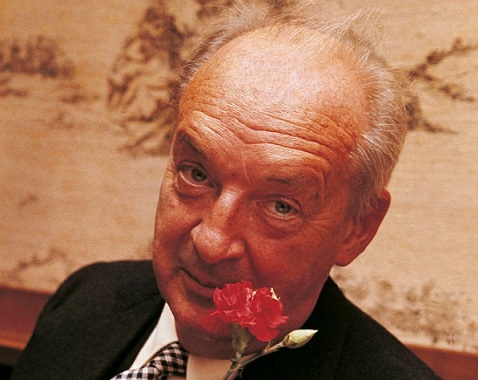
Image by Giuseppe Pino, via Wikimedia Commons
The writers who most stay with me are those who tend to write about reading: its pleasures, difficulties, and at times impossibility. Wallace Stevens, Franz Kafka, and Vladimir Nabokov belong in this category. Stevens’ essays in The Necessary Angelattempt to reconcile Plato and the Poets; reading for him is akin to a mystical union with ideas. For Kafka, reading is an act of ascetic self-harm: we should read only books that “wound and stab us… wake us up with a blow on the head… affect us like a disaster… grieve us deeply.” And for Nabokov reading can be a form of disciplined edification… and dissection. He wields his critical mind like a scalpel in his collectedLectures on Literature, in which we find a “little quiz” he devised for his students to test their thinking about what makes a “good reader.” One such quality, he suggests is the possession of an “artistic sense.”
Good readers, Nabokov suggests, should already have acquired this sense before they even approach a book. This doubtless leaves a great many people out, though he also implies in his criteria that learned qualities as well as innate ones play a role in the activity of reading, and that “artistic sense” can be learned. But Nabokov did not simply make a list—that would give it away too easily and we wouldn’t learn anything (about, perhaps, the qualities of bad readers). The professorial novelist never missed a chance to educate, and occasionally condescend to, his readers. In this case, he made a quiz with “ten definitions of a reader, and from these ten,” he had students choose the “four definitions that would combine to make a good reader.”
Take his good reader quiz, below, and see if you can quickly identify the other three qualities Nabokov requires. I doubt you’ll have much trouble. He provides his answers further down.
Select four answers to the question what should a reader be to be a good reader:
1. The reader should belong to a book club.
2. The reader should identify himself or herself with the hero or heroine.
3. The reader should concentrate on the social-economic angle.
4. The reader should prefer a story with action and dialogue to one with none.
5. The reader should have seen the book in a movie.
6. The reader should be a budding author.
7. The reader should have imagination.
8. The reader should have memory.
9. The reader should have a dictionary.
10. The reader should have some artistic sense.
The students leaned heavily on emotional identification, action, and the social-economic or historical angle. Of course, as you have guessed, the good reader is one who has imagination, memory, a dictionary, and some artistic sense–which sense I propose to develop in myself and in others whenever I have the chance.
|
|
 |
 |
 |
 |
 |
 |
 |
 |
 |
 |
 |
 |
 |
 |
 |
 |
 |
 |
 |
 |
 |
 |
 |
 |
 |
 |
 |
 |
 |
 |
 |
 |
 |
 |
 |
 |
 |
 |
 |
 |
 |
 |
 |
 |
 |
 |
 |
 |
 |
 |
 |
 |
 |
 |
 |
